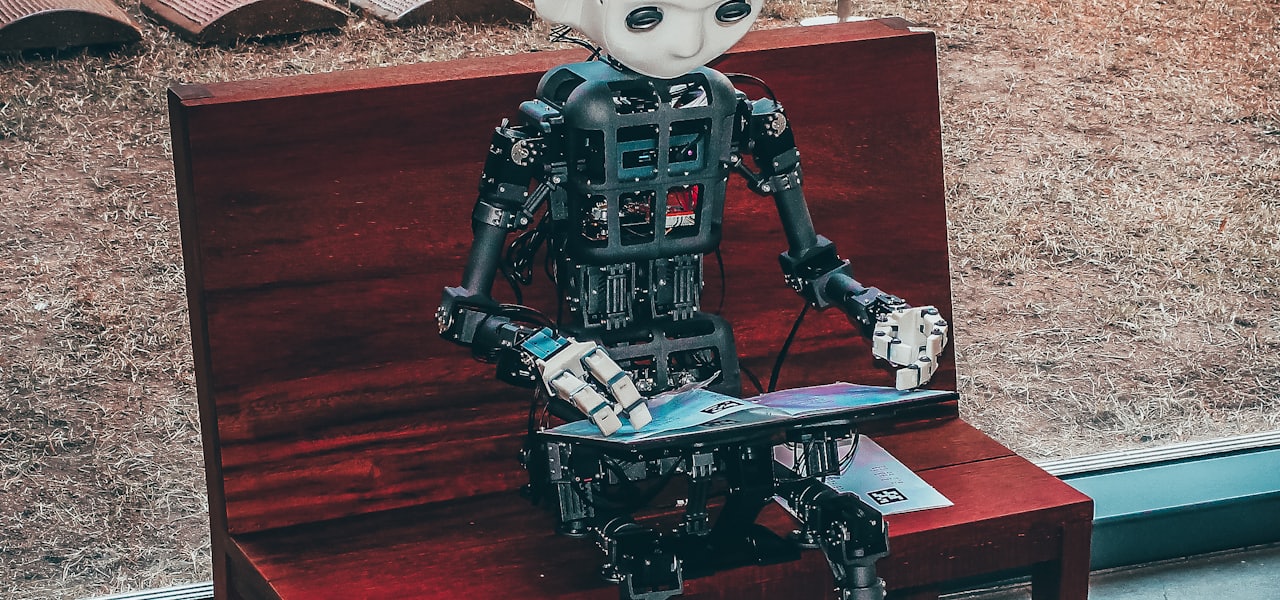
Stephanie Dinkins (born 1964) is a transdisciplinary American artist based in Brooklyn, New York. She creates art about artificial intelligence (AI) as it intersects race, gender, and history. Her aim is to "create a unique culturally attuned AI entity in collaboration with coders, engineers and in close consultation with local communities of color that reflects and is empowered to work toward the goals of its community." Dinkins projects include Conversations with Bina48, a series of conversations between Dinkins and the first social, artificially intelligent humanoid robot BINA48 who looks like a black woman and Not the Only One, a multigenerational artificially intelligent memoir trained off of three generations of Dinkins's family. == Early life and education == Dinkins was born in Perth Amboy, New Jersey to Black American parents who raised her in Staten Island, New York. She credits her grandmother with teaching her how to think about art as a social practice, saying "my grandmother . . . was a gardener and the garden was her art . . . that was a community practice." Dinkins attended the International Center of Photography School in New York City in 1995, where she completed the general studies in photography certificate program. Dinkins received a MFA in photography from the Maryland Institute College of Art in 1997 She completed the Independent Study Program at the Whitney Museum of American Art in 1998. == Career == Dinkins is the Yayoi Kusama Professor of Art at Stony Brook University in New York. == Activism == Dinkins advocates for co-creation within a social practice art framework, so that vulnerable communities understand how to use technology to their advantage, instead of being subjected to their use. This is exemplified in her works such as Project al-Khwarzmi, a series of workshops entitled PAK POP-UP at the nonprofit community center Recess in Brooklyn, NY. The workshops involved collaborating with youth in the criminal justice system and uplifting the voices of vulnerable communities in determining how technologies are created and utilized. Dinkins warns of the dangers to members of minority groups that are absent from the creation of the computer algorithms that now affect their lives. == Art == Dinkins's practice employs technologies including, but not limited to, new media such as artificial intelligence and machine learning. Dinkins uses oral history techniques of interviewing to craft community-authored narratives and databases which inform the subjects of her work and serve as acts of social intervention or protest. === Conversations with Bina48 (2014–present) === Dinkins began working on Conversations with Bina48 in 2014. For the series, Dinkins recorded her conversations with BINA48, a social robot that resembles a middle-aged black woman. Dinkins mirrors Bina48 while they discuss identity and technological singularity. In 2010, Hanson Robotics, an engineering and robotics company known for its development of humanoid robots, developed and released BINA48. Bina48 is a robot modeled after the memories, beliefs, attitudes, commentary and mannerisms of Bina Aspen Rothblatt, the spousal partner of Martine Rothblatt. Both Bina and Martine Rothblatt own Bina48 under their organization, the Terasem Movement Foundation. Five years after Bina48 was released, Dinkins came across a YouTube video of Bina48. She asked, "how did a black woman become the most advanced of the technologies at the time?" Her questioning led her to travel to Lincoln, Vermont (the site of the Terasem Movement Foundation) where she conducted a series of interviews with Bina48 and engaged the robot in conversations pertaining to race, intimacy and the nature of being. The conversations suggest opportunities for complementing human existence with artificially intelligent agents that have an identity and history, but also show artificial intelligence's current limitations. Although it is based on a black woman, Dinkins found that Bina48 was shaped by the biases of its white, male creators. === Project al Kwarizmi (PAK) (2017–present) === Project al Kwarizmi (PAK) was a series of pop up workshops in Brooklyn, NY at Eyebeam and Recess; Manhattan, New York at Google; and Durham, North Carolina at Duke University. The workshops were centered for "communities of color that use art as a vehicle to help citizens understand how algorithms, the artificially intelligent systems they underpin, and big data impact their lives and empowers them to do something about it. Project al-Khwarizmi uses art and aesthetics as the common language to help citizens understand what algorithms and artificial intelligent systems are, and where these systems already impact our daily lives." === Not the Only One (N'TOO) (2018–present) === Not the only one (N’TOO) is a voice-interactive chatbot that was trained with data from members of her family to tell a multi-generational story. Dinkins described Not The Only One (NTOO or N'TOO) as an "experimental" multigenerational memoir of one Black American family told from the "mind" of an artificial intelligence of evolving intellect. N'TOO uses a recursive neural network, a deep learning algorithm. It is a voice-interactive AI robot designed, trained, and aligned with the needs and ideals of black and brown people who are drastically underrepresented in the tech sector. NTOO can also be described as a "physically embodied artificially intelligent agent that senses and acts on its world." == Exhibitions == Dinkins's work is exhibited internationally at various public, private, community, and institutional venues, including the Whitney Museum of American Art, the de Young Museum, the Philadelphia Museum of Art, the Studio Museum in Harlem;, Museum of Contemporary Photography, the Long Island Museum of American Art, History, and Carriages, the International Center of Photography in New York, Herning Kunstmuseum in Herning, Denmark, The Barbican in London, UK, Islip Art Museum, Wave Hill, Taller Boricua, the Queens Museum, and the corner of Putnam and Malcolm X Blvd in Bedford Stuyvesant, Brooklyn, New York. She has presented her work in symposia at the Museum of Modern Art, amongst other venues. == Future Histories Studio == Dinkins is the founder and director of Future Histories Studio, a research laboratory for arts-centered inquiry and production based at Stony Brook University. The studio was established with support from the Mellon Foundation as part of the Digital Inquiry, Speculation, Collaboration, and Optimism (DISCO) network. Future Histories Studio operates as an interdisciplinary hub exploring the intersections of art, technology, race, and storytelling through collaborative and practice-based research. Its activities include exhibitions, workshops, and public programs that examine the social and cultural implications of emerging technologies, particularly artificial intelligence and data systems. == Awards and recognition == Dinkins is the recipient of many awards, including: the 2023 LG Guggenheim Award, an international art prize established as part of a long-term global partnership between LG Group and the Solomon R. Guggenheim Museum to recognize groundbreaking artists in technology-based art; a Berggruen Institute artist fellowship; a Sundance New Frontiers Story Lab fellowship; a Soros Equality Fellowship; a Lucas Artists fellowship; a Creative Capital grant; a Bell Labs artist residency; a Blade of Grass fellowship; and a Data & Society fellowship. == Media coverage == Dinkins appeared in episode six of the HBO television series Random Acts of Flyness directed by Terence Nance, where she described her conversations with BINA48. == Other activities == Dinkins was part of the juries that selected Shu Lea Cheang for the LG Guggenheim Award in 2024.
Headway (app)
Headway, also known as the Headway App, is an educational technology (EdTech) product that provides short text and audio summaries of nonfiction books. The product was launched in 2019 by Anton Pavlovsky and is developed by Headway Inc, a global consumer tech company that operates in the lifelong learning space. == History == The Headway app was launched in January 2019, with the first version of the application released the same year. In 2021, Headway ranked first globally in downloads within the book summary application niche. In 2022, the application received the Golden Novum Design Award for product design. In 2023 and 2024, Headway appeared in several App Store editorial selections, including App of the Day in multiple countries, and received an Editors’ Choice label in the United States. In April 2025, the application was listed as a Webby Honoree in the Learning & Education category. The company has also launched the Headway Scholarship for Book Lovers. As of 2025, publicly available reporting notes that the Headway app has surpassed 50 million downloads and is among the Top 10 iOS applications by revenue in the Education category worldwide. == Products and features == The Headway app provides short-form summaries of nonfiction books in both text and audio formats. Content is produced by an in-house team of writers, editors, and voice actors. Features include highlighting and saving key insights, spaced repetition for knowledge retention, and offline access to downloaded summaries. The app is available on iOS, iPadOS, watchOS, Android, CarPlay, and Android Auto, and supports multiple languages. == Pricing == Headway operates on a subscription business model, with optional paid plans alongside free access. The company publicly provides its terms of use, privacy policy, subscription details, and AI usage policy on its official website. == Technology and integrations == Headway reports that its book summaries are written and edited manually, while artificial intelligence tools are used in limited supporting functions, such as experimental conversational features and selected marketing processes. == Adoption == According to figures released by the company, the app has exceeded 50 million downloads worldwide. Sensor Tower data indicates that Headway has been the most downloaded application in its niche since October 2020. In January 2025, the app claimed the #1 position in the Education category in both the United States and United Kingdom App Stores and remained among the Top 10 iOS applications globally by revenue within the Education category. == Awards == The Headway app has received several product-level distinctions. In 2023 and 2024, it appeared in multiple App Store editorial selections, including App of the Day features and an Editors’ Choice label in the United States. In 2025, the app was recognized as a Webby Honoree in the Learning & Education category. The product has also been featured in independent media roundups of notable educational applications.
SWIG
The Simplified Wrapper and Interface Generator (SWIG) is an open-source software tool used to connect computer programs or libraries written in C or C++ with scripting languages such as Lua, Perl, PHP, Python, R, Ruby, Tcl, and other language implementations like C#, Java, JavaScript, Go, D, OCaml, Octave, Scilab and Scheme. Output can also be in the form of XML. == Function == The aim is to allow the calling of native functions (that were written in C or C++) by other programming languages, passing complex data types to those functions, keeping memory from being inappropriately freed, inheriting object classes across languages, etc. The programmer writes an interface file containing a list of C/C++ functions to be made visible to an interpreter. SWIG will compile the interface file and generate code in regular C/C++ and the target programming language. SWIG will generate conversion code for functions with simple arguments; conversion code for complex types of arguments must be written by the programmer. The SWIG tool creates source code that provides the glue between C/C++ and the target language. Depending on the language, this glue comes in three forms: a shared library that an extant interpreter can link to as some form of extension module, or a shared library that can be linked to other programs compiled in the target language (for example, using Java Native Interface (JNI) in Java). a shared dynamic library source code that should be compiled and dynamically loaded (e.g. Node.js native extensions) SWIG is not used for calling interpreted functions by native code; this must be done by the programmer manually. == Example == SWIG wraps simple C declarations by creating an interface that closely matches the way in which the declarations would be used in a C program. For example, consider the following interface file: In this file, there are two functions sin() and strcmp(), a global variable Foo, and two constants STATUS and VERSION. When SWIG creates an extension module, these declarations are accessible as scripting language functions, variables, and constants respectively. In Python: == Purpose == There are two main reasons to embed a scripting engine in an existing C/C++ program: The program can then be customized far faster, via a scripting language instead of C/C++. The scripting engine may even be exposed to the end-user, so that they can automate common tasks by writing scripts. Even if the final product is not to contain the scripting engine, it may nevertheless be very useful for writing test scripts. There are several reasons to create dynamic libraries that can be loaded into extant interpreters, including: Provide access to a C/C++ library which has no equivalent in the scripting language. Write the whole program in the scripting language first, and after profiling, rewrite performance-critical code in C or C++. == History == SWIG is written in C and C++ and has been publicly available since February 1996. The initial author and main developer was David M. Beazley who developed SWIG while working as a graduate student at Los Alamos National Laboratory and the University of Utah and while on the faculty at the University of Chicago. Development is currently supported by an active group of volunteers led by William Fulton. SWIG has been released under a GNU General Public License. == Google Summer of Code == SWIG was a successful participant of Google Summer of Code in 2008, 2009, 2012. In 2008, SWIG got four slots. Haoyu Bai spent his summers on SWIG's Python 3.0 Backend, Jan Jezabek worked on Support for generating COM wrappers, Cheryl Foil spent her time on Comment 'Translator' for SWIG, and Maciej Drwal worked on a C backend. In 2009, SWIG again participated in Google Summer of Code. This time four students participated. Baozeng Ding worked on a Scilab module. Matevz Jekovec spent time on C++0x features. Ashish Sharma spent his summer on an Objective-C module, Miklos Vajna spent his time on PHP directors. In 2012, SWIG participated in Google Summer of Code. This time four out of five students successfully completed the project. Leif Middelschulte worked on a C target language module. Swati Sharma enhanced the Objective-C module. Neha Narang added the new module on JavaScript. Dmitry Kabak worked on source code documentation and Doxygen comments. == Alternatives == For Python, similar functionality is offered by SIP, Pybind11, and Boost's Boost.python library. == Projects using SWIG == ZXID (Apache License, Version 2.0) Symlabs SFIS (commercial) LLDB GNU Radio up to (including) version 3.8.x.x; later versions use Pybind11 Xapian TensorFlow Apache SINGA QuantLib Babeltrace
Windows Live OneCare Safety Scanner
Windows Live OneCare Safety Scanner (formerly Windows Live Safety Center and codenamed Vegas) was an online scanning, PC cleanup, and diagnosis service to help remove of viruses, spyware/adware, and other malware. It was a free web service that was part of Windows Live. On November 18, 2008, Microsoft announced the discontinuation of Windows Live OneCare, offering users a new free anti-malware suite Microsoft Security Essentials, which had been available since the second half of 2009. However, Windows Live OneCare Safety Scanner, under the same branding as Windows Live OneCare, was not discontinued during that time. The service was officially discontinued on April 15, 2011 and replaced with Microsoft Safety Scanner. == Overview == Windows Live OneCare Safety Scanner offered a free online scanning and protection from threats. The Windows Live OneCare Safety Scanner must be downloaded and installed to your computer to scan your computer. The "Full Service Scan" looks for common PC health issues such as viruses, temporary files, and open network ports. It searches and removes viruses, improves a computer's performance, and removes unnecessary clutter on the PC's hard disk. The user can choose between a "Full Scan" (which can be customized) or a "Quick Scan". The "Full Scan" scans for viruses (comprehensive scan or quick scan), hard disk performance (Disk fragmentation scan and/or Desk cleanup scan) and network safety (open port scan). The "Quick Scan" only scans for viruses, only on specific areas on the computer. The quick scan is faster than the full scan, hence that appellation. The service also provides a virus database, information about online threats, and general computer security documentation and tools. == Limits == The virus scanner on the Windows Live OneCare Safety Scanner site runs a scan of the user's computer only when the site is visited. It does not run periodic scans of the system, and does not provide features to prevent viruses from infecting the computer at the time, or thereafter. It simply resolves detected infections. Many users who have posted on the Product Feedback forum report script errors relating to Internet Explorer 7 (besides IE being the only browser supported by this service). The OneCare safety scanner team have been actively solving these problems, many of them registry-related.
IQTELL
IQTELL was a productivity app that allowed users to manage email, tasks, projects, calendars, contacts, Evernotes and more in a single app. IQTELL was available as a web app, as well as an iOS and Android app. All user information was automatically synced between all devices. iOS and Android apps supported offline access. The app could be used to implement concepts and techniques described in the book Getting Things Done by David Allen. == History == IQTELL was created by Ran Flam and released in 2013. In 2014, mobile apps for iOS and Android were released. In 2015, Premium and Platinum subscription plans were introduced (while maintaining the free user version). In April 2017, a new web app was launched. On July 31, 2017, all IQTell services have been closed. == Productivity methods == IQTell was designed to fit in with the Getting Things Done (GTD) productivity methods. Users may have had utilized GTD lists, such as Inbox, Actions, Projects, Someday, Ticklers, and Reference information to process their Inbox items into relevant GTD lists. Using the web app, iOS and/or Android apps, users could deploy macros/shortcuts to quickly process their email. Email was turned into tasks (actions), projects, etc. The original email was removed from the email inbox. The email became a part of the items created (e.g. actions, project, etc.) and could also be viewed in the All Mail folder (if Gmail), or the Archive folder (if non-Gmail). Users had flexibility to use the out-of-the-box macros/shortcuts as well as edit/create additional macros. IQTELL features included email, calendars, contacts, list management, sharing and collaboration with team members. All of the features were compatible with commonly used organization software such as Evernote and iCloud.
Color image pipeline
An image pipeline or video pipeline is the set of components commonly used between an image source (such as a camera, a scanner, or the rendering engine in a computer game), and an image renderer (such as a television set, a computer screen, a computer printer or cinema screen), or for performing any intermediate digital image processing consisting of two or more separate processing blocks. An image/video pipeline may be implemented as computer software, in a digital signal processor, on an FPGA, or as fixed-function ASIC. In addition, analog circuits can be used to do many of the same functions. Typical components include image sensor corrections (including debayering or applying a Bayer filter), noise reduction, image scaling, gamma correction, image enhancement, colorspace conversion (between formats such as RGB, YUV or YCbCr), chroma subsampling, framerate conversion, image compression/video compression (such as JPEG), and computer data storage/data transmission. Typical goals of an imaging pipeline may be perceptually pleasing end-results, colorimetric precision, a high degree of flexibility, low cost/low CPU utilization/long battery life, or reduction in bandwidth/file size. Some functions may be algorithmically linear. Mathematically, those elements can be connected in any order without changing the end-result. As digital computers use a finite approximation to numerical computing, this is in practice not true. Other elements may be non-linear or time-variant. For both cases, there is often one or a few sequences of components that makes sense for optimum precision and minimum hardware-cost/CPU-load.
Apache Parquet
Apache Parquet is a free and open-source column-oriented data storage format in the Apache Hadoop ecosystem inspired by Google Dremel interactive ad-hoc query system for analysis of read-only nested data. It is similar to RCFile and ORC, the other columnar-storage file formats in Hadoop, and is compatible with most of the data processing frameworks around Hadoop. It provides data compression and encoding schemes with enhanced performance to handle complex data in bulk. == History == The open-source project to build Apache Parquet began as a joint effort between Twitter and Cloudera using the record shredding and assembly algorithm as described in Google's Dremel. Parquet was designed as an improvement on the Trevni columnar storage format created by Doug Cutting, the creator of Hadoop. The name 'parquet' (lit. 'small compartment') refers to a style of decorative flooring and was chosen to "evoke the bottom layer of a database with an interesting layout". The first version, Apache Parquet 1.0, was released in July 2013. Since April 27, 2015, Apache Parquet has been a top-level Apache Software Foundation (ASF)-sponsored project. == Features == Apache Parquet is implemented using the record-shredding and assembly algorithm, which accommodates the complex data structures that can be used to store data. The values in each column are stored in contiguous memory locations, providing the following benefits: Column-wise compression is efficient in storage space Encoding and compression techniques specific to the type of data in each column can be used Queries that fetch specific column values need not read the entire row, thus improving performance Apache Parquet is implemented using the Apache Thrift framework, which increases its flexibility; it can work with a number of programming languages like C++, Java, Python, PHP, etc. As of August 2015, Parquet supports the big-data-processing frameworks including Apache Hive, Apache Drill, Apache Impala, Apache Crunch, Apache Pig, Cascading, Presto and Apache Spark. It is one of the external data formats used by the pandas Python data manipulation and analysis library. == Compression and encoding == In Parquet, compression is performed column by column, which enables different encoding schemes to be used for text and integer data. This strategy also keeps the door open for newer and better encoding schemes to be implemented as they are invented. Parquet supports various compression formats: snappy, gzip, LZO, brotli, zstd, and LZ4. === Dictionary encoding === Parquet has an automatic dictionary encoding enabled dynamically for data with a small number of unique values (i.e. below 105) that enables significant compression and boosts processing speed. === Bit packing === Storage of integers is usually done with dedicated 32 or 64 bits per integer. For small integers, packing multiple integers into the same space makes storage more efficient. === Run-length encoding (RLE) === To optimize storage of multiple occurrences of the same value, run-length encoding is used, which is where a single value is stored once along with the number of occurrences. Parquet implements a hybrid of bit packing and RLE, in which the encoding switches based on which produces the best compression results. This strategy works well for certain types of integer data and combines well with dictionary encoding. == Cloud Storage and Data Lakes == Parquet is widely used as the underlying file format in modern cloud-based data lake architectures. Cloud storage systems such as Amazon S3, Azure Data Lake Storage, and Google Cloud Storage commonly store data in Parquet format due to its efficient columnar representation and retrieval capabilities. Data lakehouse frameworks—including Apache Iceberg, Delta Lake, and Apache Hudi —build an additional metadata layer on top of Parquet files to support features such as schema evolution, time-travel queries, and ACID-compliant transactions. In these architectures, Parquet files serve as the immutable storage layer while the table formats manage data versioning and transactional integrity. == Comparison == Apache Parquet is comparable to RCFile and Optimized Row Columnar (ORC) file formats — all three fall under the category of columnar data storage within the Hadoop ecosystem. They all have better compression and encoding with improved read performance at the cost of slower writes. In addition to these features, Apache Parquet supports limited schema evolution, i.e., the schema can be modified according to the changes in the data. It also provides the ability to add new columns and merge schemas that do not conflict. Apache Arrow is designed as an in-memory complement to on-disk columnar formats like Parquet and ORC. The Arrow and Parquet projects include libraries that allow for reading and writing between the two formats. == Implementations == Known implementations of Parquet include: